Protocol case · How we catch a narrative
The Zcash case.
In brief
- The edge is not prediction — it is being early to the right narrative and patient enough to own it through the fear. This piece sets out the repeatable process, with ZEC as the worked example.
- We identified financial privacy as a durable, under-owned narrative in 2021, and Zcash as its most investable expression — a high-conviction position held since.
- The thesis: privacy is a monetary property. Zcash delivers it through selective-disclosure zk-SNARKs — shielded by default, auditable by choice — at the overlap of sovereign money and post-quantum security.
- What turned the thesis into a return was timing: accumulating through the low-sentiment range of 2022–23, holding with conviction. Process, not prophecy.
Anyone can recognise a narrative once the market is shouting it. The work — and the alpha — is in catching it while it is still quiet, judging whether it is real, and owning the best expression of it through the part of the cycle that tests conviction. Zcash is the clearest example of that process in practice: a position we formed in 2021 and have held since.
How we catch a narrative
The method is deliberately repeatable — it is meant to be run again on the next theme, not admired once:
- Scan the field. Start wide — the top of the market by capitalisation — and map it by sector and narrative, not by price.
- Filter by narrative strength. Ask which themes the next cycle rewards, and which are already consensus. We want the story that is structurally true but not yet crowded.
- Judge the fundamentals. Team and ethics; tokenomics and supply discipline; roadmap and technical resilience; defensibility against peers; community quality; and — decisively — market capitalisation against the size of the problem the asset addresses.
- Select the premier expression. One best-in-class name that owns the theme, not a basket that dilutes it.
- Time it to the cycle. Accumulate in low-sentiment ranges; harvest into euphoria.
"Acquire amid fear, divest amid greed." Boring price action with strong fundamentals is not a problem to avoid — it is the entry.
Run end to end, the process is a search for asymmetry: a small, durable network set against a large and growing problem, bought at the point of maximum disinterest.
The 2021 call — why ZEC, and why early
The conviction has a personal root. A 2019 encounter with a bank — questioned over ordinary withdrawals of one's own money — crystallised a simple idea: privacy is a property of money, not a feature bolted onto it. By 2021 we had turned that instinct into a thesis and run the process on it. Financial privacy screened as a structural, under-owned narrative; among the assets expressing it, Zcash was the premier option.
The reason it screened best is the same reason it remains the holding: selective disclosure. Private by default, revealable by choice, Zcash can live on regulated rails where Monero's mandatory privacy invites delisting and Dash's lighter obfuscation is hard to defend as true privacy. We built the position through a stretch of regulatory uncertainty, when the name was unloved and the price action was, in a word, boring.
Privacy as a monetary property — the thesis
The dominant settlement layers — Bitcoin, Ethereum, Solana — optimise for throughput and verifiability, and they achieve it by making every transaction public. That transparency helps auditors; it is corrosive for ordinary financial life, exposing counterparties, balances, and patterns to anyone, in perpetuity. The regulatory direction of travel — MiCA, the tightening net around mixers — narrows the space for private, self-custodied settlement at exactly the moment more economic life moves on-chain. That gap, between rising demand for privacy and a constrained supply of it, is where a durable thesis lives.
Zcash separates two ideas most chains conflate — verification and exposure. Using zk-SNARKs, the network validates that a transaction is well-formed without revealing its participants or amounts. Holdings can be shielded or transparent, and a shielded holder can disclose selectively to a chosen auditor, counterparty, or regulator. That selectivity is the commercially important detail: privacy that can be revealed on the holder's terms is compatible with compliance without surrendering the default.
Two further legs reinforce the case. First, a post-quantum posture: the move to Halo 2 removed Zcash's original trusted setup — long its most-cited criticism — and the same line of work improves the network's standing against the day quantum computers threaten today's cryptography, placing ZEC at the overlap of two themes we underwrite, sovereign money and post-quantum security. Second, stewardship and supply: a fixed cap of 21 million units with periodic halvings (~16.5m circulating), open-source development and external audits across a multi-year history under the Electric Coin Company and the Zcash Foundation, and real usage — mobile shielded wallets like Zashi and rising shielded-pool adoption. Within privacy protocols, selective disclosure is the durable edge.
Timing: accumulate in the fear
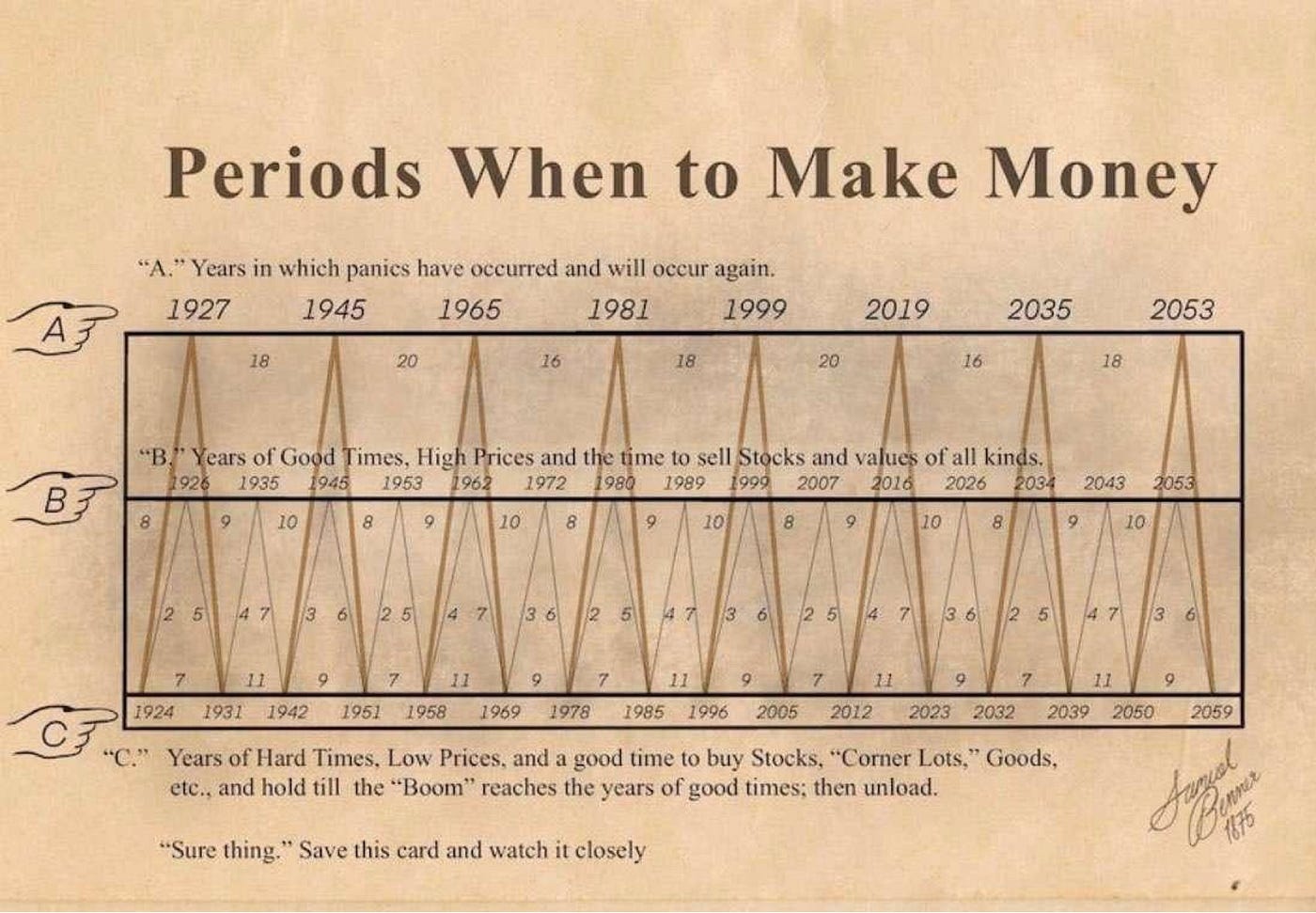
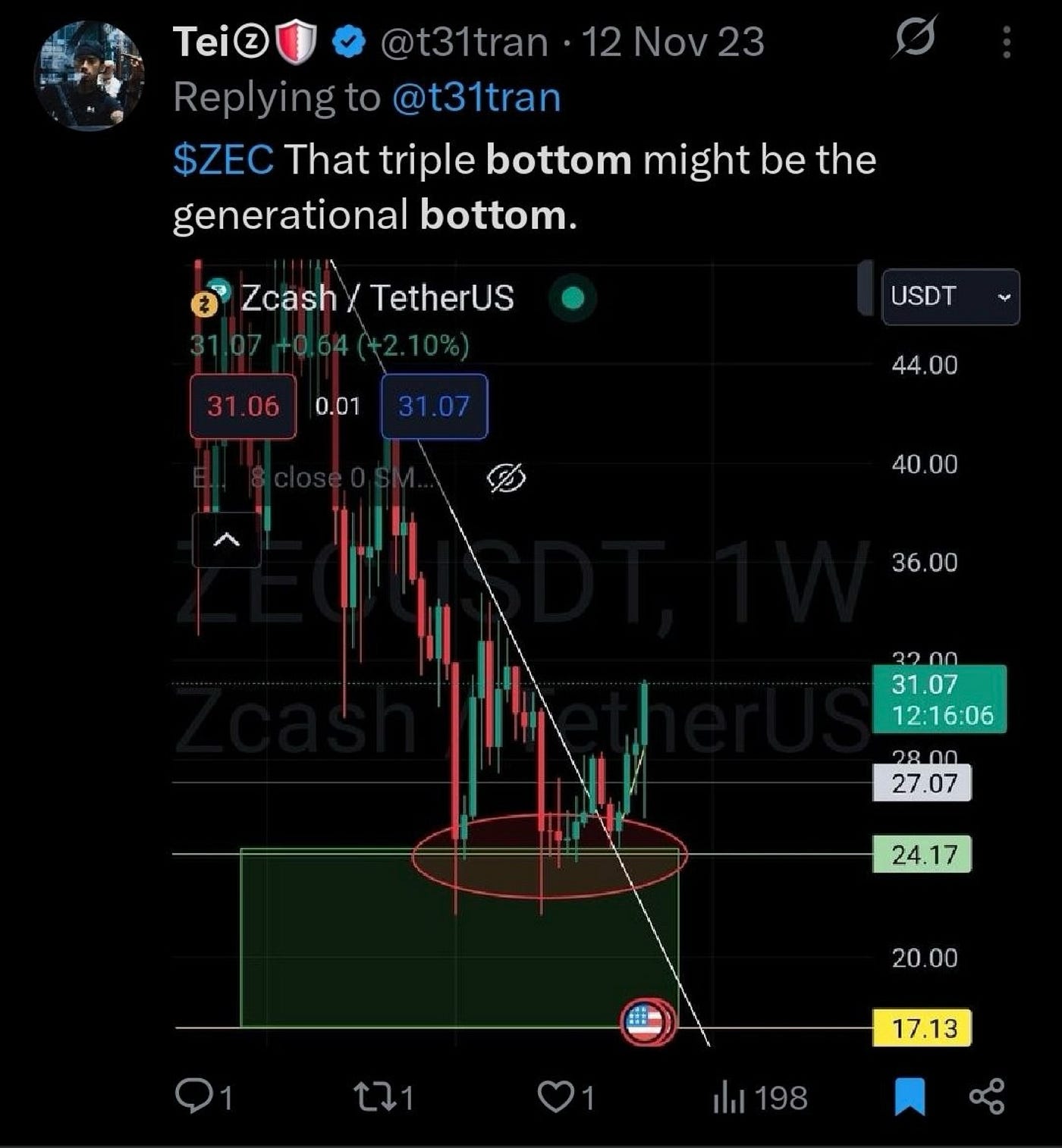
A good thesis returns nothing without the discipline to act on it when it is uncomfortable. We weigh networks on capitalisation, not unit price, and we treat range-bound, low-sentiment periods as where conviction is accumulated, not abandoned. For ZEC, that meant building through the 2022–23 bear — years of base-building, minimal narrative, maximum disinterest.
The call, in hindsight
The point of showing the work is not the number; it is the method. Early to the narrative in 2021, when ZEC traded in the low hundreds of dollars; disciplined through the drawdown, accumulating into the 2022–23 fear; and patient as the thesis re-rated — into the mid-hundreds by early 2026. Same process, every step: scan, filter, judge, select, time.
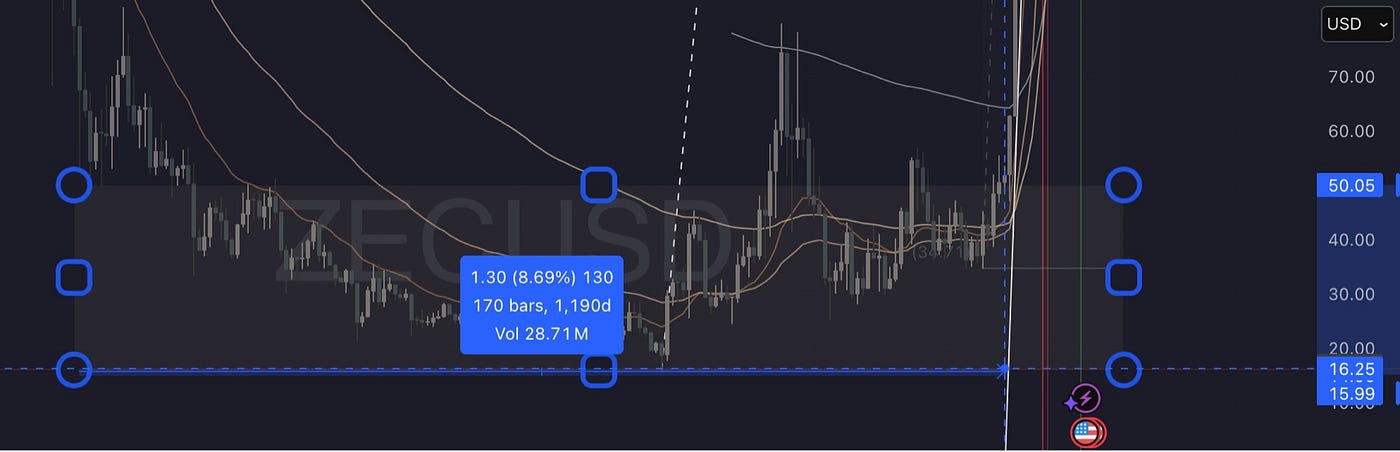
We draw a hard line between history and forecast. The path above is a record of a process working once; it is not a prediction, a recommendation, or a promise that the next call resolves the same way. What carries forward is the discipline, not the outcome.
How we hold it
A thesis is not a position. Within our sovereign money & privacy theme, exposure is sized to risk, expressed through the strategy type that fits the opportunity — directional when the edge is clear, structured where it is not — and carries a defined way to be wrong. We accumulate in low-sentiment ranges, harvest into strength, and never confuse a tradable move with a permanent one. The edge is process, not prediction.
Risks
Privacy-native money carries live engineering risk, and 2026 made the point. In May–June, a critical counterfeiting vulnerability in Zcash's Orchard circuit — under-constrained since the pool's 2022 activation and, in theory, capable of minting unlimited ZEC — was uncovered by an AI-assisted security audit (researcher Taylor Hornby), responsibly disclosed, and patched within days via an emergency soft fork and the NU6.2 hard fork, with a further Ironwood upgrade (July 2026) replacing the affected pool. No malicious exploitation was identified, but ZEC fell sharply on the disclosure. We read the episode both ways: a reminder that even the leading privacy chain runs real cryptographic-engineering risk — and a live demonstration of the audit-and-respond discipline this thesis says to watch for.
- Regulatory: privacy assets face delisting and access risk as supervision tightens; selective disclosure mitigates but does not eliminate it.
- Cryptographic & implementation: zk-SNARK systems and the post-quantum transition are active research, and circuit bugs — as the 2026 Orchard flaw showed — can lie latent for years after deployment; both assumptions and code can change.
- Liquidity and execution: smaller networks carry wider spreads and venue concentration, and disclosures like the above can drive sharp drawdowns.
- Adoption & repeatability: the privacy thesis is durable but its realisation is not guaranteed on any timeline, and a process that worked once can still fail the next time. Digital assets can lose all value.
Related — future-proof money: quantum, surveillance, and the case for Zcash →
This perspective is for informational purposes only and is not investment, legal, or tax advice, nor an offer or solicitation. Performance and price references are historical and illustrative, are not indicative of future results, and are not a recommendation. Zecadium may hold positions in assets discussed. Digital assets are volatile and carry substantial risk, including total loss of capital. Intended for qualified / accredited investors. Zecadium is operated by Centrent, part of the Trancent world.